Timeswap ETH/USDC LPs supply different assets on either side of the transition price
Timeswap ETH/USDC liquidity providers supply ETH when its spot price is below the transition price and USDC when it's above that price. Express both prices in USDC per ETH. The supplied token funds borrowing against collateral in the other asset. Automated market maker (AMM) pricing and arbitrage incentives explain this relationship without an external price feed.
Single-asset liquidity still supports several claims inside the pool. The choice between ETH and USDC establishes the supplied token; the interest component determines a separate part of LP exposure.
The token an LP supplies follows the pool's price relationship, while borrower repayment can change the asset received at settlement.
Spot price determines the supplied side of an ETH/USDC pool
Below the transition price, ETH occupies the supplied-asset role and borrowers use USDC collateral to obtain ETH from the pool. Above that threshold, USDC occupies the supplied-asset role and borrowers lock ETH collateral. Liquidity providers support the same borrowing direction that the pool's price relationship makes economically viable. The pool doesn't permanently assign ETH to collateral or USDC to lending.
The transition ratio connects the token amounts
The transition price establishes how the pool relates amounts of ETH and USDC; it doesn't report ETH's current market price.
The AMM's constant-sum component treats transition-price-equivalent quantities of the tokens equally. Their outside market values can differ. Arbitrage incentives favor adding the relatively cheaper asset and removing the more valuable equivalent, which explains the pool's economically preferred supplied side.
No price feed tells the contract which token has become cheaper. Participants make that comparison through their transactions. Calling the deposit choice price-dependent therefore doesn't mean the protocol imports an oracle price.
The constant-product component handles a different relationship: available assets against interest reserves. The ratio of interest reserves to asset reserves determines the pool's marginal interest rate.
A hypothetical price comparison reverses the deposit asset
In this hypothetical comparison, an ETH/USDC pool has a transition price of 2,146 USDC per ETH. Compare spot prices of 1,986 and 2,306 USDC per ETH while keeping its maturity unchanged.
At the lower spot price, the pool's transition ratio equates 1 ETH with 2,146 USDC. The market values that ETH at 1,986 USDC, which is 160 USDC less than the equivalent USDC quantity. ETH therefore fills the supplied-asset role and USDC serves as collateral.
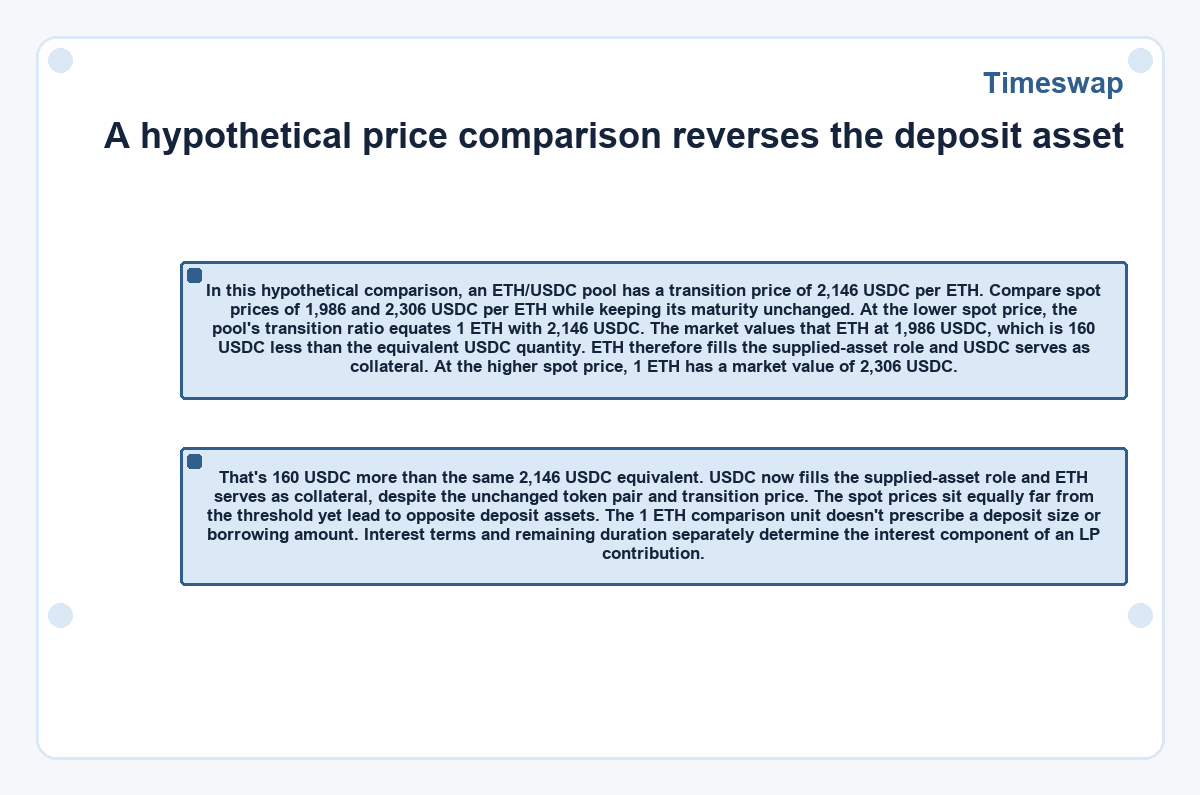
At the higher spot price, 1 ETH has a market value of 2,306 USDC. That's 160 USDC more than the same 2,146 USDC equivalent. USDC now fills the supplied-asset role and ETH serves as collateral, despite the unchanged token pair and transition price.
The spot prices sit equally far from the threshold yet lead to opposite deposit assets. The 1 ETH comparison unit doesn't prescribe a deposit size or borrowing amount. Interest terms and remaining duration separately determine the interest component of an LP contribution.
A single-asset deposit funds principal and interest components
An LP supplies one token while contributing to both the asset and interest components that connect lenders with borrowers inside the pool.
In the AMM notation, X and Y represent token reserves measured on the pool's transition-ratio basis. Z represents interest per second. A proportional liquidity addition preserves the pool's ratio of interest reserves to asset reserves. Adding liquidity therefore differs from a lending transaction, which changes that ratio.
The asset component provides capital that borrowers can obtain. The interest component supports the other side of lenders' interest claims. Although one deposited token funds both components, their economic functions differ, so the whole deposit doesn't behave like a fixed-rate lending position.
Remaining time also enters the calculation. If d denotes seconds until maturity, d multiplied by an increment in Z represents the corresponding interest amount. An interest-per-second quantity isn't a complete token amount until the calculation includes its duration.
The pair name leaves important pool parameters unspecified
A specific ETH/USDC pool combines its token pair, transition price and maturity, so the same pair can support different supplied-asset choices across different pools. Each pool's threshold governs its own price comparison. Maturity determines the remaining duration used in its interest calculation. A price relationship for one pool therefore doesn't establish the deposit asset or interest component for every ETH/USDC market.
LP earnings reflect the interest spread
Liquidity providers earn transaction fees and carry exposure to the balance between interest paid by borrowers and interest owed to lenders. Borrowing and lending activity changes the AMM's interest ratio. An LP's return consequently varies with that activity, even though individual lending and borrowing positions establish fixed interest terms at entry. The fee that a transaction pays uses lending or borrowing interest as its calculation base. Actual activity determines the fees that a position earns.
The interest component of an LP position carries divergence-loss exposure when pool interest rates fall relative to the entry rate. The lending-principal component doesn't carry that same divergence exposure. It still carries borrower-default exposure. For a position held through maturity, interest receipts reflect rates over the holding period. The final displayed APR alone doesn't describe that history.
The supplied asset can differ from the settlement asset
An LP's eventual token receipts depend on borrower repayment across the pool, even when the LP originally contributed only ETH or USDC.
Repayment supports settlement in the supplied asset. If borrowers don't repay before maturity, their forfeited collateral contributes to settlement instead. Aggregate borrower outcomes can therefore produce claims on supplied assets and collateral.
The transition price influences the economic incentive to repay because it relates the debt and collateral amounts. It doesn't compel every borrower to make the same decision. A movement across that price also doesn't trigger a price-based liquidation of existing loans. Their maturity and repayment conditions remain relevant.
Available liquidity limits what an early exit returns
An early LP withdrawal requires available pool liquidity and can incur slippage, so permission to exit doesn't promise immediate recovery of every underlying amount. Interest-rate changes also affect the interest component's withdrawal value. The amount that an interface displays for a position can consequently differ from the amount available through an early withdrawal.
When stronger borrowing demand leaves liquidity scarce, an LP may recover only part of the lending principal before maturity. The remaining claim can require waiting until the pool expires. A higher interest rate can improve the interest-side outcome while restricting immediate access to principal.
Holding ETH or USDC in a wallet preserves direct ownership of that token balance. Supplying it as liquidity creates exposure to the pool's interest spread, borrower repayment and exit conditions.
Questions and answers about Timeswap
What happens if ETH's spot quote uses the inverse of the pool's transition-price quote?
Convert the quotes to the same direction before comparing their values. A spot quote in ETH per USDC can't be compared directly with a transition price in USDC per ETH. Taking a reciprocal reverses the numerical ordering, so mixing those directions can lead to the wrong conclusion about whether ETH or USDC supplies the pool.
Can I change the transition price when adding to an existing ETH/USDC pool?
An existing pool retains the transition price that its creator established. Adding liquidity supports that pool's existing parameters; it doesn't create a personal transition price for the new LP. A different transition price identifies a different pool, even when both pools contain ETH and USDC.
How do LP receipts differ from the ETH or USDC that I deposit?
LP receipts represent claims on a pool position rather than an ordinary ETH or USDC balance. Liquidity Tokens use the ERC-1155 standard to represent a share of pool liquidity. The underlying assets and claim value can change with interest conditions and borrower repayment, so the receipt doesn't promise a fixed quantity of the deposited token.
Why can an ETH/USDC LP withdrawal require two approvals?
The position representation separates Liquidity Earning Fees from Liquidity Earning Yield, with ERC-1155 tokens representing each component. Removing liquidity can therefore require approvals for both position-token types. The approvals apply to the Timeswap position collections; they don't grant access to unrelated NFT collections.
Does another pool's repayment shortfall directly reduce this ETH/USDC pool's assets?
Each pool isolates its lending and borrowing exposure, so another pool's borrower defaults don't automatically charge this pool. That separation doesn't eliminate this pool's own collateral or interest-spread exposure. Pools involving the same assets can also face the same market-price movement, even though their settlement claims remain separate.
At exactly the transition price, which asset has the lower relative value?
At equality, an ETH quantity and the USDC amount that matches it at the transition ratio have equal spot value. The price comparison alone therefore gives no preference between supplying ETH and supplying USDC. This equality doesn't determine the position's interest outcome or remove its exposure to borrower repayment.
Updated ·