Timeswap maturity fixes the repayment deadline and starts settlement
Timeswap maturity is the fixed expiry that separates a borrower's repayment window from settlement of the pool. Borrowers must repay before that timestamp to recover their locked collateral. Lenders and liquidity providers (LPs) can then redeem claims on the assets left after repayment or default. A fixed interest rate describes a position's terms, while borrower decisions determine whether settlement contains the supplied asset, forfeited collateral or a mixture. Earlier exits in Timeswap V2 follow different pricing rules and depend on available liquidity. The expiry therefore answers when obligations change, without fixing the market value of every asset that a position ultimately returns.
The expiry connects a pool's debt and asset claims
Timeswap V2 uses the token pair, transition price and maturity to identify the pool whose debts and asset claims settle together. The first liquidity provider sets those initial parameters. Pools with the same pair can have different expiry times or transition prices, giving them separate terms and liquidity. A pair name alone can't establish when a position ends. The maturity attached to that particular pool governs its repayment window and the settlement of its claims.
Remaining seconds determine the interest horizon
Duration measures the time left until the pool expires, so entering later means interacting with a shorter remaining term. The automated market maker, or AMM, uses a duration variable, d, measured in seconds. Its Z component represents interest per second. Multiplying Z by d expresses the remaining interest component in the pool. Z can change with lending and borrowing activity, while the passage of time reduces d.
An annual percentage rate, or APR, expresses a yearly rate; it isn't the percentage earned over every pool's remaining life. A position opened partway through a term doesn't receive a fresh term measured from its entry. Its interest covers the relevant period before the existing expiry. Later lending and borrowing can change the quote for new positions without changing an earlier position's locked-in rate.
Repayment must finish before the cutoff
Borrowers must repay before pool maturity to reclaim their locked collateral. The date includes an exact time, so treating it as an entire day leaves the deadline ambiguous.
Before expiry
Closing the debt returns the repayment asset to the pool and unlocks collateral. An early close uses its applicable exit quote.
At the boundary
An unpaid position reaches expiry with its collateral still locked. The borrower forfeits that collateral for settlement to lenders and liquidity providers. The absence of price-triggered liquidation doesn't extend the repayment window, and a later rise in collateral value doesn't change the expired deadline.
Lender redemption reflects the pool's repayments
A lender's maturity claim covers principal and fixed interest, while borrower decisions collectively determine the assets that settle it. The settlement can contain both tokens when participants leave different assets behind, so a pool-wide outcome needn't match one borrower's decision exactly.
Debt that borrowers repay
If all borrowers repay their debts, lenders redeem principal and interest in the supplied asset. Those repayments restore the token that borrowers obtained from the pool.
Debt that borrowers leave unpaid
Default leaves collateral to support lender and LP claims. Receiving that collateral preserves a token claim under the pool's terms; its market value can differ from the value of the asset originally lent. A fixed interest entitlement doesn't establish a fixed value in a separate currency.
The transition price describes repayment incentives
The transition price relates the amount of debt to the collateral behind it, helping explain borrowers' economic choices near expiry. A borrower has an incentive to recover collateral worth more than the debt needed to release it. Lower collateral value can favor forfeiture. These are incentives, not an automatic promise that every borrower follows the same action. The assets actually left in the pool determine settlement. A spot-price move doesn't itself liquidate the loan.
A hypothetical price change alters the repayment choice
Consider a borrower comparing a predictable full-term debt with the value of collateral near expiry. All amounts and prices in this example are hypothetical. An ETH/USDC position has a full-term debt of 1,312.50 USDC, locks 0.7 ETH and has a transition price of 1,875 USDC per ETH. Compare timely repayment with leaving that same position unpaid.
The transition ratio connects the quantities: 1,312.50 USDC divided by 1,875 USDC per ETH equals 0.7 ETH. This establishes the collateral amount associated with the debt. It doesn't establish the collateral's market value or an individual lender's allocation.
At a spot price of 2,035 USDC per ETH, the collateral is worth 1,424.50 USDC. That's 112 USDC more than the full-term debt. If the borrower repays before expiry, the pool receives USDC and releases the 0.7 ETH.
Change only the spot price to 1,765 USDC per ETH. The same collateral is worth 1,235.50 USDC, or 77 USDC less than the debt. If the borrower leaves the position unpaid, expiry forfeits the 0.7 ETH. That ETH remains available for the pool's lender and LP claims.
The changed price reverses the value comparison while the debt and collateral quantity stay fixed. An earlier repayment still uses its actual exit quote. The price differences above compare collateral value with full-term debt; they aren't a forecast of profit or the amount that any single lender receives.
Does early repayment reduce interest in proportion to time?
Early repayment doesn't apply a simple proportional reduction to the original interest amount, because the exit also interacts with AMM pricing. Elapsed borrowing time matters alongside interest rates at entry and exit. Available liquidity affects price impact. A higher exit rate relative to entry increases the interest proportion that the borrower pays, so the calendar alone can't determine the closing cost.
The fixed maturity amount remains the reference for the full term. A pre-maturity closing quote answers a different question: what the borrower must return to close the position at that point. Dividing the original interest by the number of days and multiplying by elapsed days won't reproduce that quote when rates or liquidity affect the exit.
Early lender withdrawals use the market's exit pricing
Withdrawing a lending position before expiry exchanges its remaining claim through the AMM, changing the amount of interest the lender realizes. Time in the position, entry and exit interest rates and available liquidity affect the withdrawal. A lower exit rate relative to entry favors the interest proportion received. The early withdrawal doesn't provide the full interest payment associated with holding through maturity.
At maturity, the remaining-duration component has run down and redemption uses the pool's settled assets. Waiting removes the need to sell the remaining term through an early-exit transaction. It retains exposure to the settlement token and its value, so avoiding early-exit slippage doesn't remove the consequences of borrower default.
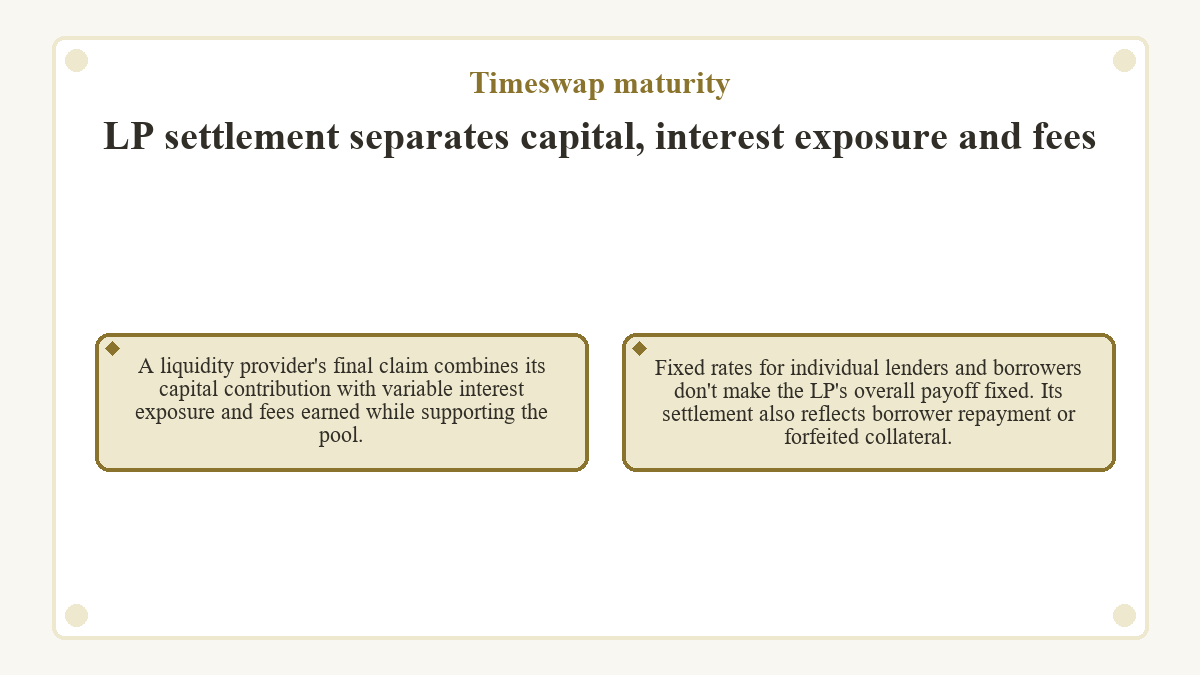
LP settlement separates capital, interest exposure and fees
A liquidity provider's final claim combines its capital contribution with variable interest exposure and fees earned while supporting the pool. Fixed rates for individual lenders and borrowers don't make the LP's overall payoff fixed. Its settlement also reflects borrower repayment or forfeited collateral.
Principal claims
Bond Tokens associated with the LP's lending capital redeem against the pool's principal and defaulted collateral. The principal component doesn't carry the interest-spread divergence exposure, although the tokens that settle it still depend on borrower outcomes. Principal coverage and a fixed market value are different properties.
The interest component
The LP's interest component supports the counterparty side of lending. Its return depends on the interest-rate path during participation. Interest-spread divergence can produce a gain or loss relative to the amount committed at entry. Before maturity, scarce liquidity can also prevent immediate recovery of all principal, leaving a claim to redeem later.
Accrued transaction fees
Fees form another claim associated with activity in the pool. At maturity, LPs redeem the underlying tokens represented by the relevant fee claims alongside their other position components. Fee earnings vary with transactions, so a fixed expiry doesn't imply a fixed fee total.
Receipt redemption releases the underlying settlement tokens
Timeswap uses ERC-1155 receipt tokens for these positions. Lenders hold Bond Tokens, or BT, and liquidity providers hold Liquidity Tokens, or LT, with associated claims. Closing and redemption burn the applicable receipts to release their underlying tokens.
Timeswap V2 maturity redemption can return a proportional mixture of the pool's two underlying tokens. A receipt balance therefore shouldn't be read as a wallet balance of the originally supplied asset. The redeemed token amounts identify the assets actually received. Their current value remains separate from the receipt's principal and interest accounting.
The app's outage restriction leaves existing closures available
When the app's data-outage notice applies, it restricts new lending, borrowing and liquidity additions while keeping existing positions available to close. That restriction concerns stale pool data and new activity. It doesn't turn a pool's maturity into a flexible deadline. Existing borrowers still face the repayment cutoff, while lenders and LPs retain the settlement conditions attached to their positions.
Liquidity and pricing still govern an early exit, even while closing remains available.
Practical questions about Timeswap maturity
Does approving tokens close a Timeswap loan before maturity?
Token approval alone doesn't repay a Timeswap loan. Closing a borrowing position requires access to the repayment token and the ERC-1155 Collateral Claim Token, followed by the closing operation that burns the receipt and unlocks collateral. An approval authorizes access; it doesn't establish that repayment finished before expiry.
What happens to a Collateral Claim Token after an unpaid loan expires?
The Collateral Claim Token loses its ability to recover locked collateral at maturity. Keeping the receipt in a wallet doesn't preserve the borrower's expired claim. The collateral instead supports lender and liquidity-provider settlement, and a later increase in its market price doesn't restore the borrower's redemption right.
How do time zones affect a Timeswap repayment deadline?
A pool has one expiry instant, even when different time-zone displays describe it. Timeswap V2 specifies maturity as a Unix timestamp, which identifies a single moment. Converting that timestamp changes the displayed clock time, so the date, time and zone must refer to the same instant when interpreting the repayment deadline.
Can waiting until maturity reverse an LP's interest-spread loss?
Waiting until maturity doesn't automatically reverse an LP's interest-spread loss. The interest component reflects the rates experienced during participation, so a lower interest return can remain part of final settlement. Maturity removes pre-maturity exit pricing, while claims accumulated as pool rates varied remain part of the position.
Is a historical TIME rewards APR part of the debt due at maturity?
A historical TIME premine rewards APR isn't the borrowing rate that determines a loan's maturity obligation. The premine ended in January 2025, and its rewards figures described a separate incentive program. A past rewards display neither changes a position's repayment terms nor establishes that those incentives remain available.
Updated ·